Is He Welcome
What are the signs that the Holy Spirit is not welcome in your life?

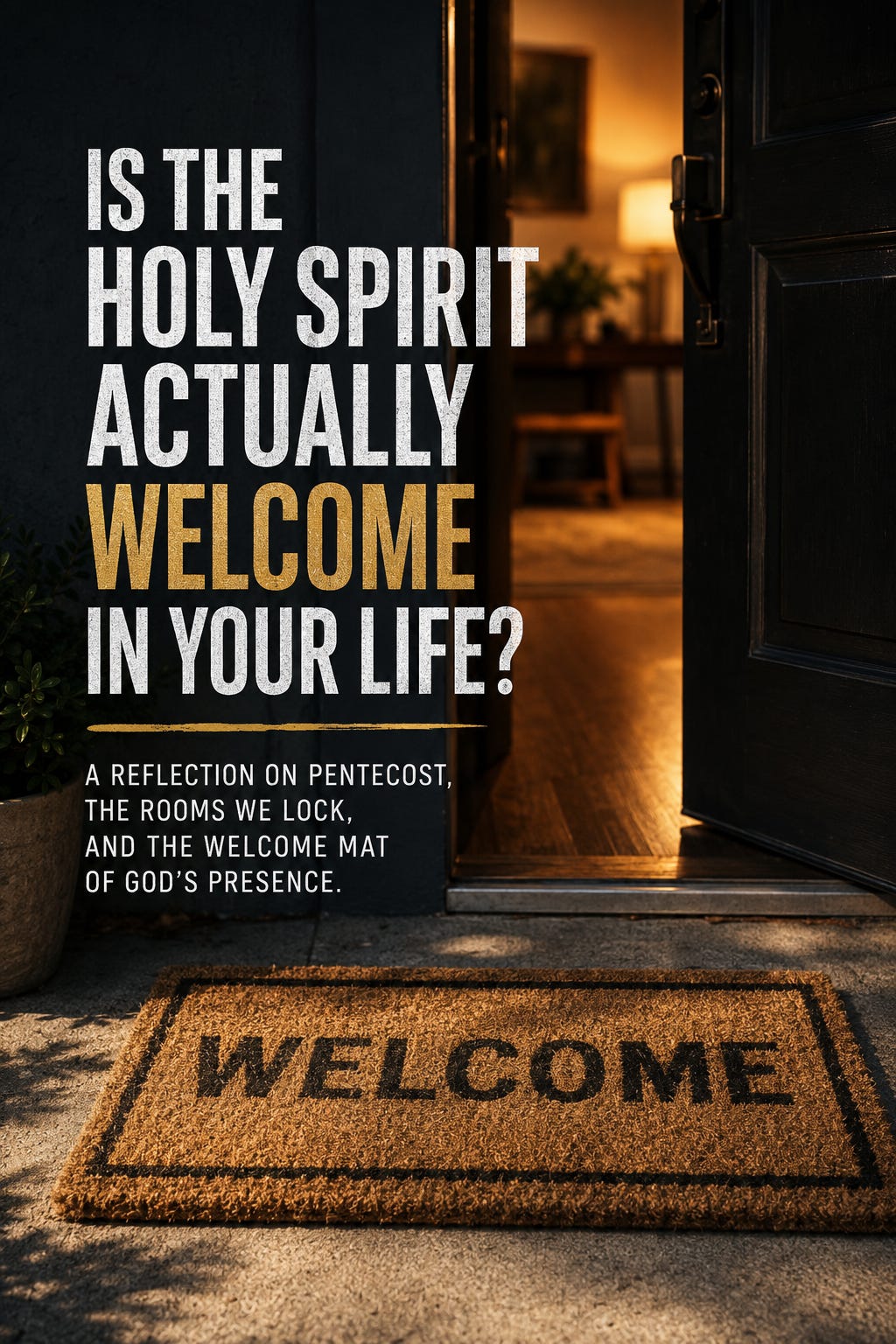
A welcome mat is a strange thing when you really think about it.
It just sits there. Quiet. Usually dirty. Sometimes faded by the sun. But before anybody speaks to you, before they shake your hand, before they even knock, the mat is already communicating.
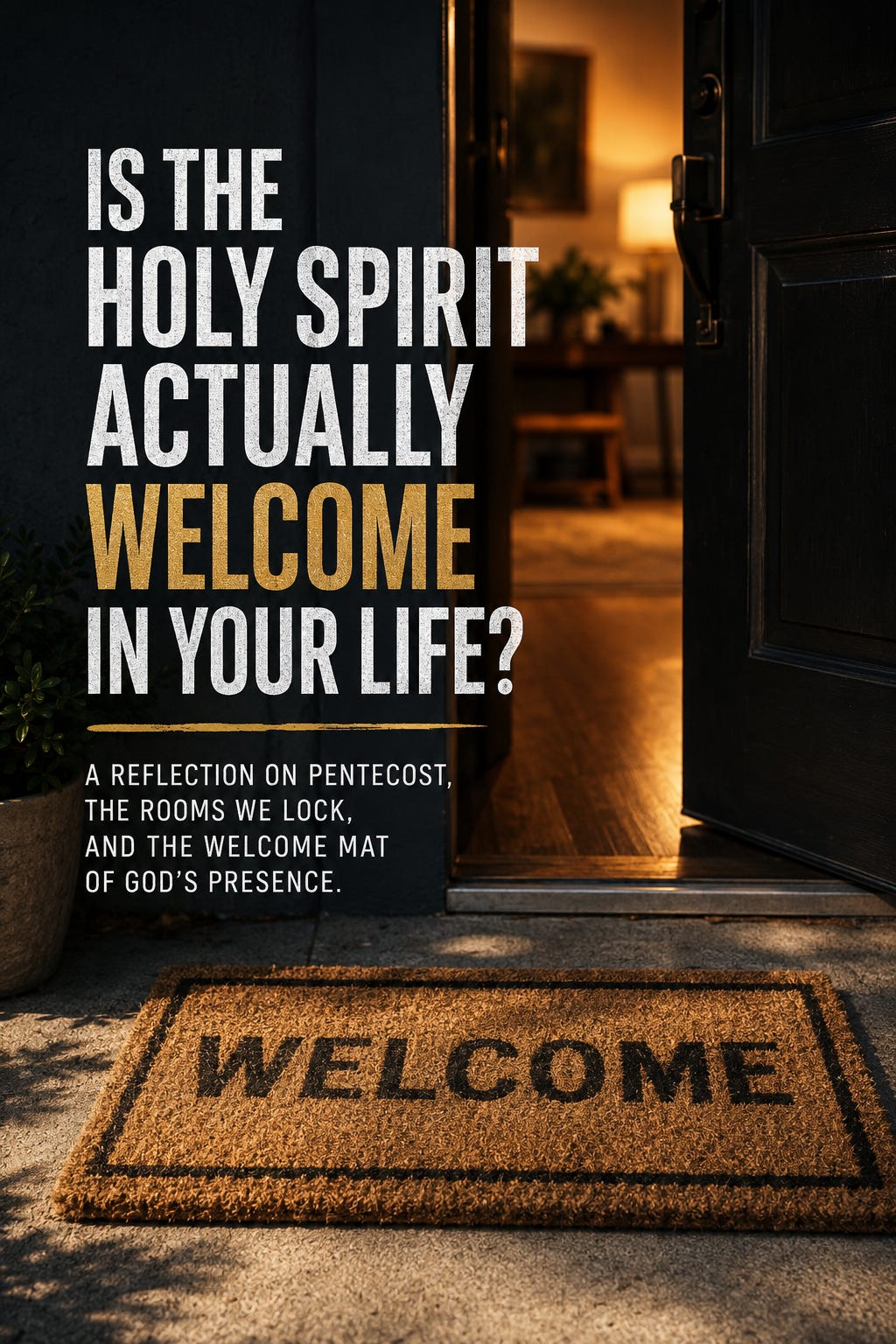
You are welcome here.
This Sunday I stood in church holding a welcome mat while preaching about Pentecost, and somewhere in the middle of the sermon I realized this message was pressing on me too. Because every person communicates something long before words arrive. Our posture communicates. Our pace communicates. The way we carry pain communicates.
Some people have built entire emotional lives that quietly say, “Please don’t come too close.”
And honestly, I understand that impulse more than I wish I did.
Acts 2 says the believers were gathered together in one place when suddenly the Spirit of God filled the room. Wind. Fire. Languages. Courage. The birth of the church. But what struck me this week is how different that room feels from the beginning of Jesus’ story.
When Mary and Joseph arrived in Bethlehem, exhausted and looking for safety, the world essentially told Jesus before He was even born, “There is no room for you here.”
No vacancy.
That ache sits underneath a lot of human life. We all know what it feels like to be unwanted somewhere. Unchosen. Unseen. To feel like your existence arrived at the wrong door.
But Pentecost feels like God creating a new kind of room.
Not a perfect room. Not a polished room. Just surrendered people willing to make space for His presence.
And I think that raises a difficult question for many of us who call ourselves Christians. If the Holy Spirit approached the front door of our actual lives, not our church attendance, not our theology, not our social media language, but our real interior world, would He genuinely feel welcome?
I think many of us love God while still keeping certain rooms locked.
For a long time, I did.
I spent years preaching sermons and helping other people process pain while quietly protecting my own. Especially the pain connected to my father. I convinced myself that shutting that emotional door was wisdom. Strength even. But eventually I sat across from him at an Airbnb in downtown Los Angeles, and during that process I started realizing something I had never fully admitted.
When you keep God out of a wound, the wound does not freeze in place. It deepens in the dark.
The anger stays alive in there. The grief keeps breathing in there. What you refuse to bring into the light quietly shapes you from underneath.
And healing rarely begins with control. It usually begins with honesty.
That is part of why I think our culture struggles so much spiritually right now. We are exhausted but distracted enough to avoid noticing it. We keep moving fast enough to outrun reflection.
I felt that recently while back in the gym. I was on the treadmill watching the numbers climb higher and higher. One mile. Two miles. Sweat everywhere. Heart pounding. But the strange thing about treadmills is you can spend enormous energy and still remain in the exact same location.
And I wonder how many people are living that way emotionally.
Busy enough to avoid silence. Productive enough to avoid grief. Surrounded by noise but disconnected from themselves.
Before Pentecost, Jesus told the disciples to wait together. That detail matters more to me now than it used to. They were still long enough to receive something. Present enough to notice heaven moving.
Most of us struggle with that.
Stillness can feel threatening because silence has a way of introducing us to whatever we have been trying not to feel.
Then there’s the deeper tension underneath all of this. Ownership.
Many of us have been trained to treat our lives like private property. My money. My schedule. My future. My comfort. Even our suffering becomes possessive after a while. My trauma. My anxiety. My disappointment. We hold pain so tightly that eventually it starts feeling inseparable from our identity.
But when the Spirit of God filled the early church, people became startlingly open with one another. They shared meals, resources, burdens, and responsibility because something fundamental had shifted inside of them. Their lives no longer revolved around self-protection.
The Holy Spirit has a way of loosening clenched hands.
That does not mean wisdom disappears. It does not mean boundaries disappear. But it does mean the illusion of total ownership starts collapsing.
Because eventually you realize your life was never fully yours to begin with.
Scripture says the same Spirit that raised Jesus from the dead now lives in us. That means Pentecost is not just a story about spiritual power descending from heaven. It is also a story about God refusing to remain distant.
God above us became Jesus beside us, and through the Spirit He now dwells within us.
That changes the atmosphere of a person.
It changes how they forgive. How they notice people. How they carry conflict. How they approach strangers. It changes the emotional temperature of a room.
Which brings me back to the welcome mat.
I think the church is supposed to become the kind of place where people can breathe again. A place where honesty is possible. A place where healing is not rushed. A place where the Spirit of God is not treated like a theological concept but like a welcomed guest.
Because once the Holy Spirit fills a room, people stop encountering performance and start encountering presence.
And maybe that is the real question underneath Pentecost.
Not whether God is real.
Not whether church matters.
But whether we are actually willing to open the door.